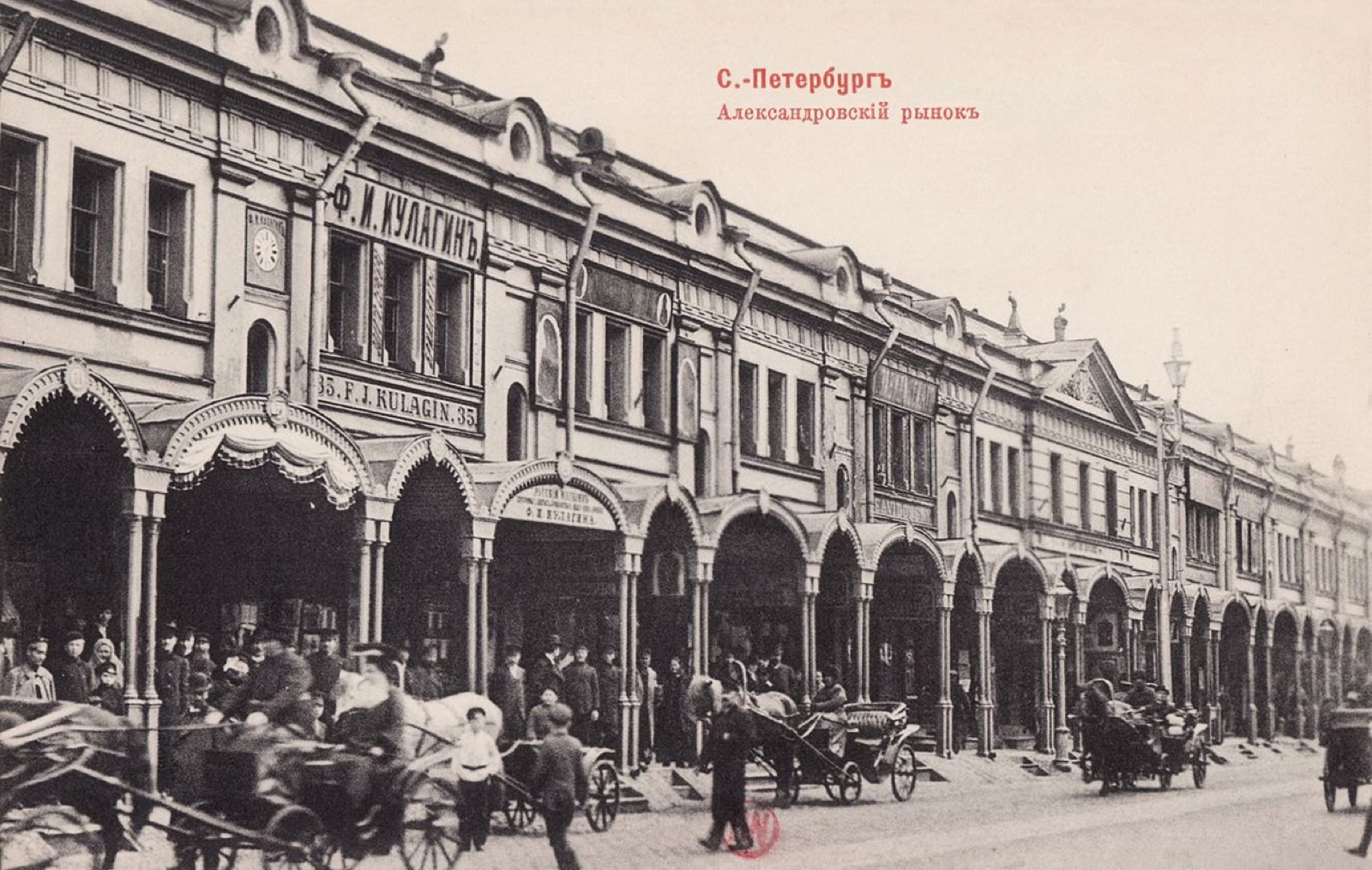
The land where the Alexandrovsky stood was given in 1862 to the Society of Merchants who had lost their stock in the Apraksin Court fire. The two-storey stone building, oval in plan, with mansards, was finished in 1868. Inside, three trading squares, a long passage running through the building with a glass roof of fixed panes, a cement floor, and lines of small, cramped, dark stalls. To inspect anything you were buying, you carried it out into the light.
The Alexandrovsky was not a food market. It sold whatever a household no longer needed: old clothes, ready-made dress, bed linen, furniture of every description. People came to buy and also to sell. Anyone with something to dispose of could bring it here and be reasonably sure of an offer from a trader who would mark it up and put it back on the stall the same week.
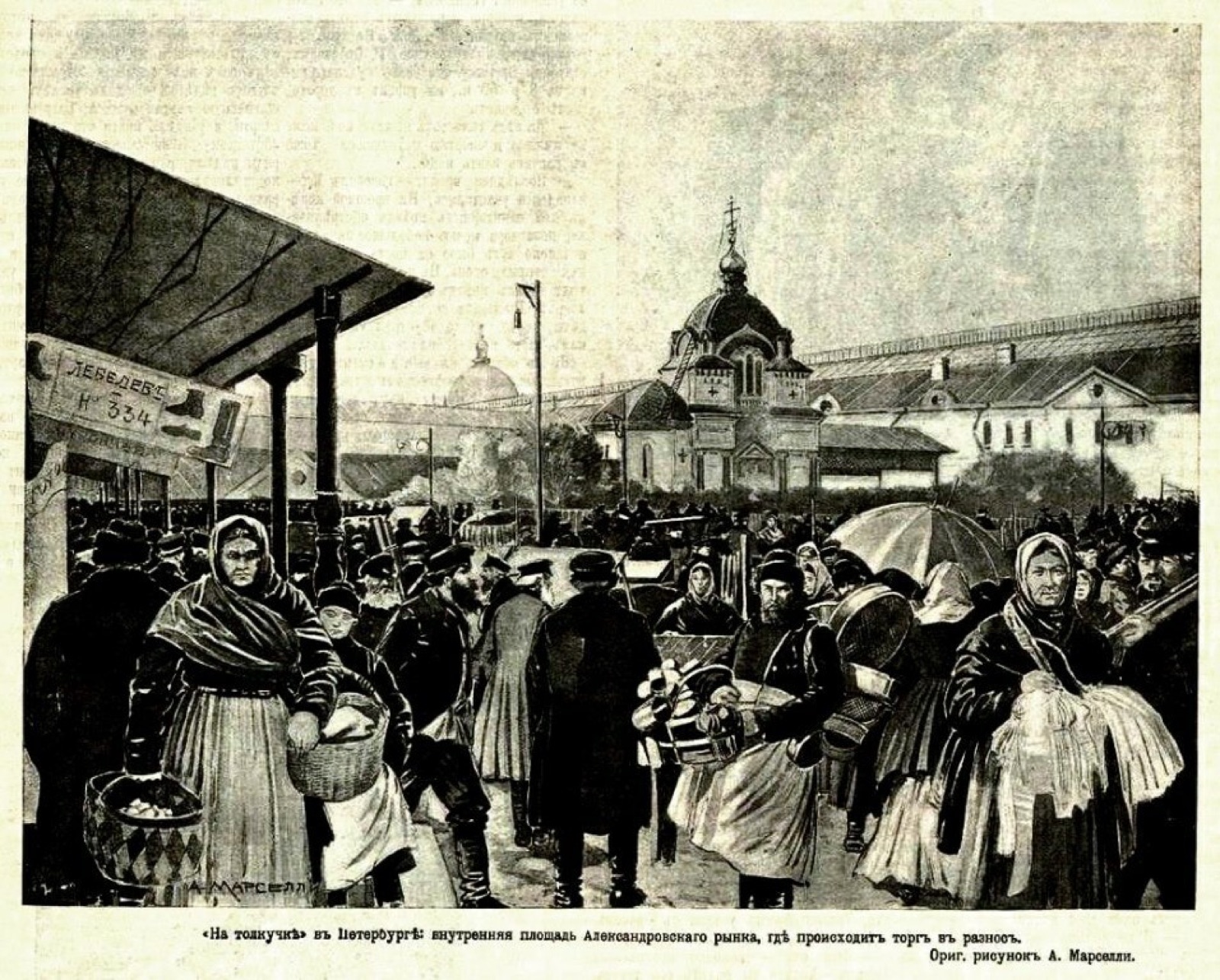
The main day was Monday — the "razval", the spill. Before dawn, while the gates were still locked, a crowd of poor traders gathered at the entrance with carts, sledges, or bundles tied with rope, full of whatever they thought might sell. When the porter finally unlocked the gates, the whole crowd rushed in to claim a patch of floor. Whoever got there first and laid out his goods held that place until the close of trade. There was no list, no allocation — only the rule that you held what you took.
And what was on offer at the razval was the city's discarded life: heaps of old boots, worn galoshes, bits of yellowed fur, stuffed birds and animals, lengths of broken rope, kerosene burners that no longer worked, lamps, dirty cotton wadding, scraps of cloth in every colour, rusted iron, old felt boots, broken furniture, papers, ribbons, shards of crockery, and filthy rags. The air was thick with dust and a smell that made you cough. Among the wreckage, traders also tried to sell new things, calling out to anyone who walked past.
The razval ran until noon and then closed. Before noon the traders worked hard to clear their pitch, because nobody wanted to drag the stuff home. By twelve, most of it was gathered up; the rest was simply left on the floor and the seller walked away. Then a second wave of buyers — the regulars — moved in to collect what had been abandoned and load it onto their own carts. Most of the basement rooms of the building were rented as storage for the rag-traders. A regular paid one or two roubles a month for a cellar and used it to stockpile old goods between markets. The Monday razval was the largest, but smaller versions ran on other days too.
Because the Alexandrovsky moved so much used clothing, it had a reputation as a source of disease. The Third district of the Spassky part of the city, where the market stood, had the highest rates of contagious illness in the capital. Petersburg doctors more than once traced a patient's illness back to a coat or a dress bought at the Alexandrovsky. Sanitary regulations forbade rag warehouses inside city limits — they were supposed to be on the edge, on Goloday island or beyond the Narva gate. Nobody at the city administration seemed to notice that the Alexandrovsky itself functioned as a giant rag warehouse in the middle of the capital. If the city had cared about public health, it would have ordered traders to disinfect their stock, or moved the razval out of the centre. Neither happened.