Reason one: the power of the church calendar
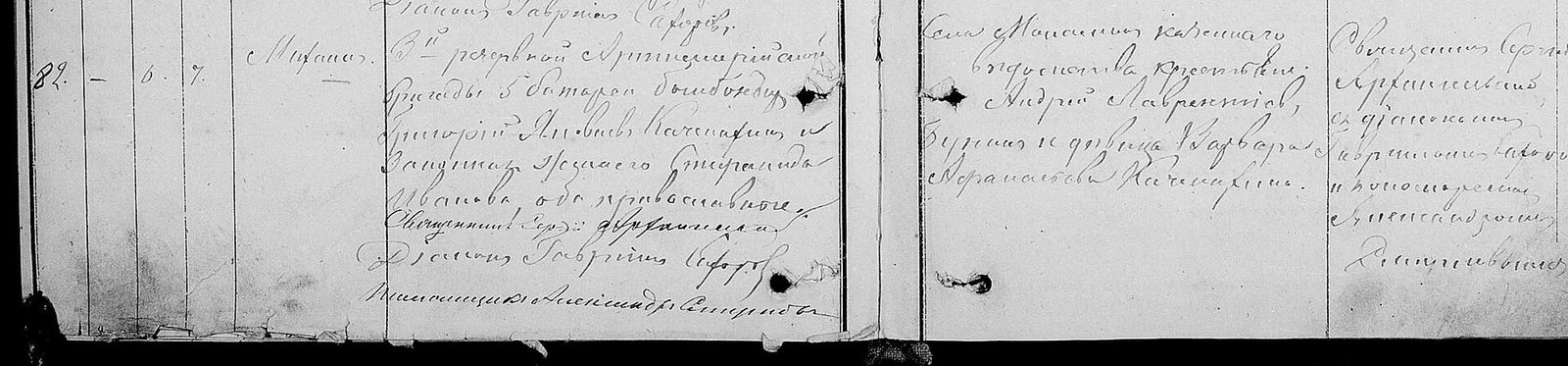
Before ZAGS was created in 1918, a child's name was given by the priest at baptism, from the church calendar of saints. The name was chosen for the saint whose feast fell on the date of birth or baptism. The set of names available in any given stretch of the year was limited: if two children in a family were born close together, they could get the same name simply because 'the priest said Andrei'. No one dared argue with the priest. As a reader of our blog recalled: 'My grandfather's family had two Andreis. To avoid confusion one was called Andrian, but both were recorded as Andrei.'
Reason two: high child mortality
In the 19th century child mortality was catastrophic. Dying in the first years of life was the rule more than the exception. When a child died, the next was often given the same name, as a tribute, as an attempt to 'restore' the one who was lost, as continuity of the line. So in one family's registers you can find an Ivan born in 1842 who died in 1845, and then an Ivan born in 1846.
Reason three: a narrow pool of names
The genealogist Alina Akatkina, working on her own family tree, found that along one line the men carried mostly three names: Ivan, Mikhail and Vasily. That is no accident. Nineteenth-century peasant life used a very narrow set of names. The hundred most common names covered the great majority of the population. Add the custom of naming children after a grandfather or father, and matching names become almost unavoidable.
How this complicates research
Picture it: you are looking for Ivan Petrov, a peasant born around 1860 in a village of 300 people. In the registers for that period you find five Ivan Petrovs of roughly the right age. Which one is your ancestor?
This is why context matters so much in genealogy: the names of godparents, of neighbours in revision-list entries, of witnesses at a wedding. All these details help you 'identify' the right person among namesakes. Without as much surviving biographical detail as possible, such documents are very hard to work with.
Double names and household nicknames
Families had a neat way of solving the confusion: unofficial household names. One Andrei might be called Andrei, the other Andrian, though both were recorded as Andrei. Some were named after a father or grandfather with 'younger', 'big' or 'little' added. In Cossack families nicknames were common, and could turn over time into second surnames.
And there was the truly unlikely. As one of our readers wrote: 'There were three brothers, born one after another, all with the same name. The funniest part is that two of them ended up marrying wives with the same name and patronymic.' Such coincidences are a real puzzle for a researcher.
What to do when names match
First, do not panic. Second, look for extra identifiers: an exact year of birth, the parents' names, the godparents, the village. Third, compare data across sources: parish registers, revision lists, confession lists. Together they usually let you identify a person beyond doubt.
Lost among namesakes and same-surname ancestors? The genealogists at Family Relic untangle the hardest cases. Find out at myrodoslovie.ru