In the beginning, a surname recorded a trade, a feature of appearance or a turn of character. That makes the history of any surname interesting in itself, because it tells you something about the people who carried it first. Where they lived, what they did, what set them apart — much of it is hidden inside the name.
A few centuries back, by-names had no weight at all. People forgot them or swapped them at will. The modern surname carries something else. For us it is tied to the line, the family's history, the inheritance of our ancestors. We treat it as a default and rarely think about what it might be hiding. People rarely take pride in a surname; in earlier centuries a surname was a privilege of the nobility, a sign of status and family unity.
Finding out why your family carries the surname it carries is less work than you might think. Online sources and dedicated sites trace the origin of a surname, the period when it appeared, and the place where it was first recorded. When the digital trail runs dry, specialists pick it up from there: archive records, family history work, a full genealogical chart.
Why look into a surname
A surname carries weight. Some people argue its influence is comparable to that of a given name or a date of birth, on the grounds that it carries its own energy. Even if that is not your view, the search for its origin is interesting work. Reasons people do it:
Understanding the family. The history of a surname is the history of the people who wore it: their culture, their customs, the patterns of their life. Connecting with relatives. The same surname can lead to distant cousins in other regions or countries — new contacts, restored ties. Cultural inheritance. A surname is part of a community's heritage. Its history opens onto the history of a people, its values and traditions. Identity. Knowing where your name came from places you in a story. It produces a sense of belonging. A starting point for deeper research. A surname is a doorway into wider genealogical work — a family tree, a family book.
What a surname means, and when surnames appeared
A child receives a given name from the parents. The surname comes down from the ancestors. That bond between the generations is exactly what makes surnames worth investigating. Perhaps an ancestor was a person of standing, perhaps your line goes back to ancient Rus and the family forgot because after the revolution people had reason to hide noble descent. Investigating the history of a surname is, therefore, something most people benefit from doing.
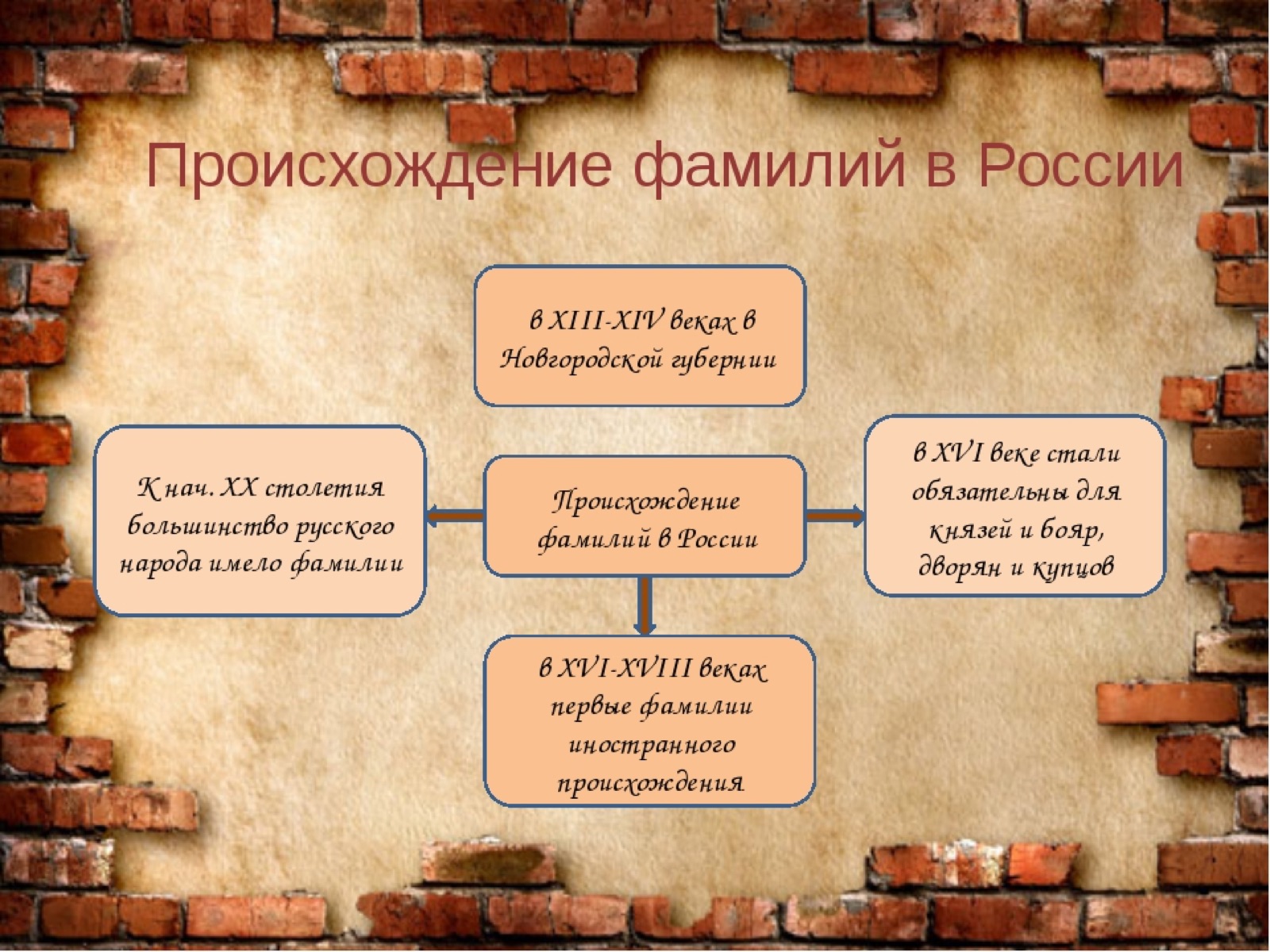
A look at the wider history. According to many researchers, the word familia comes from ancient Rome. In that period it meant something different — Romans used it for a group of people, a community, including the head of a noble household, their dependants and their slaves. Familia was a unit through which financial and political matters were handled and control of the lower orders maintained. After the fall of the Western Roman Empire the concept went dormant. The stable family name returned via the Italian institution of inheritance. The first stable surnames in Italy appear at the end of the tenth century. France picked up the practice next. Genealogical lines became an exclusive service for the wealthy noble houses. In England the formation of surnames continued until the fifteenth century; in remote parts of Wales and Scotland it ran later still. Germans, Danes and Swedes acquired surnames at the end of the sixteenth century, although until the late eighteenth century these were often nominal.
Reading the history of your family through the surname
In Russia, surnames appeared mainly because identification was needed. With populations growing in villages and towns, there were too many people with the same given name. By-names let neighbours tell them apart — in one village you might find Ivan the Squinter and Ivan the Redhead. Some chose their by-names; others received them on account of their appearance. Serfs could not choose at all — their owners named them however they pleased, which produced a long list of awkward and sometimes humiliating by-names. The surname Shcherbakov, specialists believe, points to a wide gap between the front teeth.
The simplest case is anyone born in Veliky Novgorod. Its chronicles run for eight hundred years, and its archive holds the names of fighters at the Battle of the Neva. Stable by-names first appear in those records. The higher classes started receiving line-markers in the 1300s, given as recognition for service or to mark belonging to a particular place. Names of this kind include Donskoy, Shuysky, Nevsky. With foreign loanwords entering Russian, surnames began to appear in foreign shape: Karamzin, Fonvizin.
While prominent nobles took recognisable surnames, peasants went without. Under Peter I the state began holding revisions — a kind of census. Stable hereditary by-names would have simplified the work. The tradition was not in place yet, and Peter's attempts to systematise the peasant population did not change matters. A peasant second name could change every generation: Ivan, son of Pyotr, was recorded in the parish books as Ivan Petrov; his son was recorded as Ivan Ivanov, and so on for the duration of the empire.
The novels of Pushkin, Lermontov and Gogol confirm that surnames remained a privilege of the privileged for a long time. A surname was rarely accidental — it reflected something specific: place of residence, trade, personal qualities. Take your own name apart morphologically. Find the root, the suffixes, the ending; identify the word underneath. A few examples of "speaking" surnames, with their historical origin:
From nationality: Polyakov, Tatarinov, Grekov, Tsyganov, Kalmykov. From place of birth or residence: Vyazemsky, Sibiryak, Kazantsev, Muromets, Belozersky, Ustyuzhanin, Yaroslavtsev. From trade: Goncharov (potter), Kuznetsov (smith), Melnikov (miller), Rybakov (fisherman), Pastukhov (shepherd), Streltsov, Molotov, Shilov, Bogomazov, Karetin. From birds or animals: Golubev, Lastochkin, Bykov, Medvedev, Belkin, Gusev, Lisitsyn, Rybin, Teterin. From military designations: Strelkov, Pushkaryov, Gusarov, Ulanov. From parents' given names: Ivanov, Petrov, Romanov, Fyodorov, Demidov, Yeliseyev, Yegorov, Marfin. From position in the family: Malyshev, Menshikov, Starshov, Tretyakov. From appearance: Belyaev, Ryzhov, Chernov, Golovach, Levshin, Kosykh. From character: Molchanov, Tikhomirov, Myagkov, Smekalov, Ostroumov, Pravdolyubov. From flowers and plants common in the area: Landyshev, Vinogradov, Rozov, Tsvetkov, Abrikosov, Kedrov, Dubov, Berezin.
So a surname does talk about the ancestors. The Melnikov and Rybakov families have a distant great-grandfather who ran a mill or fished for a living. The Ustyuzhanins are from Veliky Ustyug, the Moskvins from Moscow. The Pushkaryovs are likely descended from an artillery man. The Ryzhovs and Chernovs probably owed their name to an unusual hair colour. Reading the surname is one of the first ways to learn about your line.
Reading the surname by its ending
A separate class of surnames belongs to the clergy and reflects the parish where they served — the so-called "priest" surnames: Blagoveshchensky, Sretensky, Vvedensky, Znamensky, Preobrazhensky, Voznesensky, Troitsky, Rozhdestvensky, Uspensky, Voskresensky, Pokrovsky. Most are formed with the suffixes -sky and -tsky. Other church surnames came from the seminary itself: Vetrinsky, Apollonsky, Zarnitsky, also Brilliantov, Almazov, Bronzov. These were often built from Latin lexicon, by transliteration (Benevolensky) or by translation (Nadezhdonostsev, the Russian version of the name of the holy martyr Elpidiforos). Platonov likely came from the name of the philosopher, Afinsky from the Greek capital. Such cleaner-sounding surnames replaced the colloquial nicknames of seminarians and underlined the higher status of clergy. So a Pokrovsky family can reasonably assume the line begins with a priest of a Pokrov (Intercession) church.
Reading the surname by social estate
If you are compiling a family tree or just interested in the family's past, anything that hints at the trade or social standing of your ancestors is useful. Surnames carry that kind of evidence. Typical surnames by estate of the Russian Empire:
Nobility. The estate existed from the thirteenth century until 1917. Originally nobles were people who served at the princely court, and later received land and peasants as reward for service. They had privileges — exemption from tax and from compulsory service, access to education and state office. Surnames here appeared early and stayed stable. Most noble lines have pedigrees reaching back into the deep past. Common noble surnames carry a clear note of high standing: Golitsyn, Sheremetev, Yusupov, Trubetskoy, Dolgoruky, Urusov. Many Russian noble families carried foreign names — through marriage, foreign service, or other channels: Fonvizin, Lermontov, Benkendorf, Bering.
Merchants. The merchants of imperial Russia ran trade and held real economic weight. Depending on the guild, a merchant might be a small market trader or a wholesale operator dealing with other cities and countries. Since merchants often came up from peasants, craftsmen or impoverished nobles, their surnames frequently mark trade or origin: Krasilnikov, Morozov, Yeliseyev, Stroganov, Demidov.
Peasants. Rural population working the land, 82% of the empire. In some regions their surnames were not recorded in parish books or other documents until the early twentieth century. Many peasant surnames were unflattering, formed from nicknames, household names or dialect words that captured a less attractive trait of appearance or character: Zlobin, Rozhin, Krivonosov, Tolstozadov, Durakov. After 1917, plenty of these were re-registered. A Kozlov could become an Aprelsky. A Negodyayev could become a Dobromilov.
When the search needs help
If working on your own does not produce results, talk to a professional. A working genealogist can run a full study, reconstruct the line, render it as a family tree, or write the family book. We provide research, tree work, and book production end to end.