
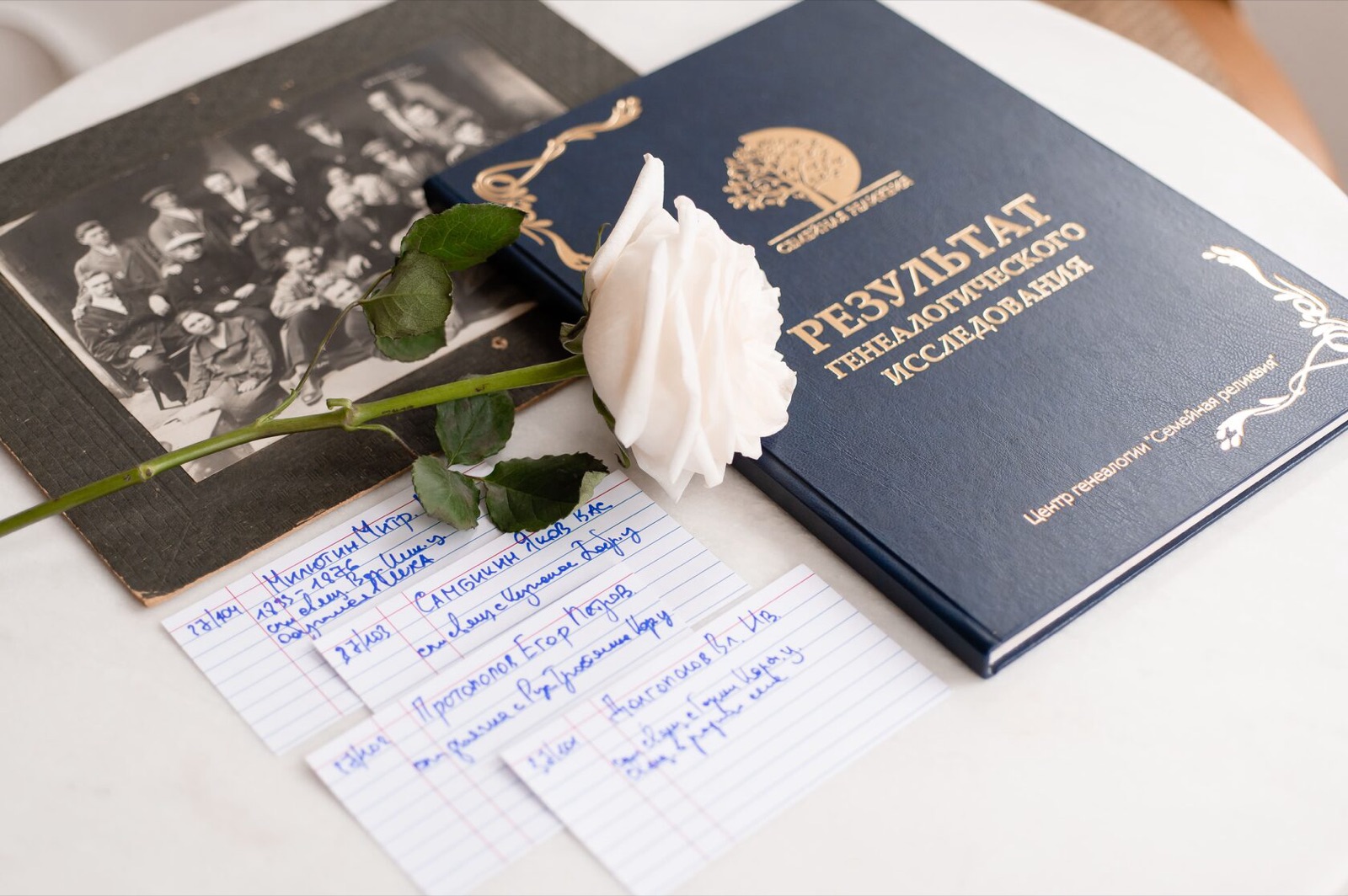
At some point most researchers stop adding rows to a spreadsheet and start asking how to turn the work into something readable. The natural answer is a book — a printed object with chapters, photographs, a tree at the back, and enough narrative to make the names mean something to children who never met the people behind them.

Gathering the material
Three sources, in order of usefulness.
The family archive
Documents, photographs, letters, certificates, employment books. Sort them by person, scan each item at high resolution, label every scan with the person and the year. Originals fade, get lost or get thrown out by the next generation. A labelled scan is what survives.
Conversations with relatives
Recorded — on a phone or a small recorder. Without the recording, half of what was said is gone within a week. Ask the oldest people first. Their generation holds the only living memory of pre-war and post-war family life. Concrete questions work better than open ones: where were they born, what did the parents do for a living, what was the village called, why did they move.
Online and archive research
Several Russian platforms are useful starting points:
- VGD (vgd.ru) — the largest Russian genealogy forum, with regional sub-forums
- Open List — the database of victims of Soviet political repression
- Memory of the People, OBD Memorial — Defence Ministry databases on WWII service
- FamilySearch — free, with scanned parish books from many regions
For older or harder-to-find records, you eventually need a state archive. Three options for working with them: writing in, going in person, or sending someone with a notarised authorisation. Each has trade-offs. Written requests are slow but cheap. A personal visit is fast but local. Delegating works well if the person you delegate to is professional.
Format choices
Before you draft a single chapter, settle the physical format. It changes the way you write.
- A5 — reads like a novel, comfortable in the hand
- A4 — fits more illustrations and document scans per page; feels more like a heritage volume
- large-format — for one or two presentation copies; not practical to print in numbers
Also pick a narrative direction. You can write from the most distant known ancestor forward, from yourself backward, or in parallel strands — paternal line, maternal line, the rest. Each works. The first one tells a strong dynastic story; the second is easier to research and easier to read; the third reflects how the family actually evolved.
The chapters that earn their place
A family book that gets read tends to share the same backbone. You don't need every section below, but you usually need most of them.
A short introduction
Why this book exists, who put it together, what you wanted the reader to feel by the end. Two or three pages. It is the part most authors over-write and most readers under-read.
A glossary
Genealogical writing introduces unfamiliar terms — parish book, revision list, descendant chart, brother-in-law versus son-in-law. A short glossary at the front saves the reader's patience.
Surname and origin
Where the family name came from, when it appears in the records, what region the family was rooted in. If the name has a clear etymology, say so. If it doesn't, say that too.
Biographies of ancestors
The largest part of the book. One section per ancestor, in a consistent template: full name, dates, place, occupation, marriage, children, what they lived through. Add document scans next to the biography, not in a separate appendix. Decode any difficult handwriting in a footnote.
The tree
At the start or the end of the book — either works, but the end is more useful, because the reader gets to it once they already know who is who.
Sources
A bibliography is what separates a family book from a piece of fiction. Every fact in the biographies should be traceable back to a specific archive file. Future researchers will thank you, and the book will hold up if anyone ever tries to use it as evidence.
Ready-made versus self-published
Two production routes.
Ready-made templates
Several Russian publishers sell pre-bound family-book templates. You buy a leather-bound volume with printed section dividers and fill in blank pages by hand or with printed inserts. Pros: the object looks finished from day one, no design work needed. Cons: you write inside someone else's structure, there is a fixed amount of space per person, and the binding does not always survive heavy use.
Self-published
You design the book yourself and have it printed. The standard layout tools:
- Adobe InDesign — industry standard for book typography
- Adobe Illustrator — useful for the tree and illustrated pages
- Microsoft Publisher — simpler, adequate for short books
- Word — works for a draft, painful for the final layout
Once the file is laid out, you choose a printer. A printing house gives you a real book with a sewn block and a hard cover but is expensive — costs depend on the print run, paper, binding and colour pages. A home printer plus a wire binder is much cheaper and adequate for working copies. We usually recommend printing two or three high-quality bound copies for the immediate family, and a larger run of softcover copies for relatives.
When a professional is worth the money
A family book is two projects in one: the research and the production. Some people do both themselves and enjoy it. Some do the research and hire out the design. Some do neither and commission the entire book.
A genealogist will read the documents you already have, identify the gaps, do the archive work needed to fill them, and write the biographies in a consistent voice. A designer will lay out the book in a typography that does not look like a school project. A printer will give you a hardback that will survive the next century. The three roles can be combined or split, and the trade-off is straightforward: more outsourcing means less time and more money.
In closing
The reason to make a family book is durability. Spreadsheets and online trees disappear with the platforms that host them. A printed book sits on a shelf, gets read once a year at the family table, and slowly becomes the official version of who the family is. The day it is finished is the day the work stops being yours and starts being the family's.


